
Field notes / Controls, decisions, and better rounds
From the desk to the putting course
Uncanny Cat Golf belongs in the same afternoon as a good Pen Fight match: a small playing field, a visible target, and a movement that looks obvious until you actually release it. Instead of knocking an opponent off a desk, you guide a square cat around miniature golf layouts. The visual joke arrives immediately, but the useful question is familiar. Where will the moving piece stop, and will that position make the next action easier? Treat the course as a collection of landing areas rather than a single line to the hole.
The strange presentation changes the mood without replacing the basic putting problem. Unsettling faces, collage-like scenery, and visual interruptions can make an ordinary shot feel unusually tense. You do not need to decode every image before playing. Start by separating what affects the route from what simply decorates the screen. This guide concentrates on that practical distinction: identifying playable space, testing power, and turning an untidy first attempt into a more deliberate second one.
Set up a first round you can actually learn from
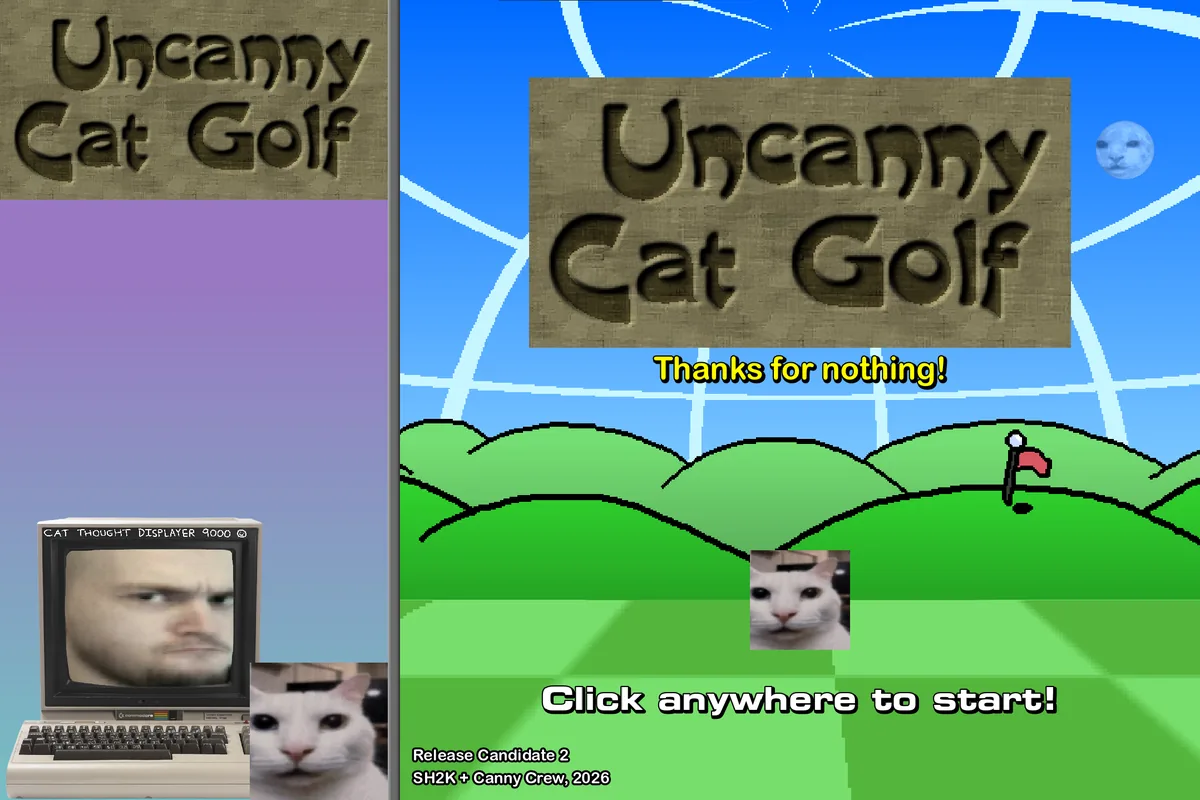
Press Play Uncanny Cat Golf in the cover above to load the embedded game. Give the frame a moment to finish loading, then click inside it so the game receives your input rather than the surrounding page. A mouse is a sensible starting point for this aim-and-release format. Follow the instructions shown by the loaded build for the exact gesture; do not assume the direction of a drag behaves identically to Pen Fight. One low-power test is more useful than guessing at full strength.
Before taking that test, notice the starting position, the nearest boundary, and the hole. Choose a direction with room for a mistake. Watch how the aiming display responds as you move, and compare the preview with the actual movement after release. If the game is hard to read at its current size, use Fullscreen. Keep the browser zoom stable during your experiments, because changing the apparent distance on screen can make your own power estimates inconsistent even when the game rules have not changed.
Power is a measurement, not a dare
A common first instinct is to pull hard enough to cross the entire layout. That can reveal a lot about the boundaries, but it rarely teaches you what a controlled shot feels like. Build a small mental scale instead. Notice what a short adjustment does, what a medium release reaches, and when extra power stops improving the position. You are not looking for a universal setting that works on every hole. You are learning how the current surface and available space respond to your input.
Change one variable at a time. If the direction was good but the cat passed the target, keep approximately the same line and reduce the power. If the distance was sensible but you missed sideways, keep the strength similar and change the angle. Changing both dramatically makes it harder to understand why the next attempt improved. This is the same useful discipline as practising a gentle Pen Fight nudge: a repeatable modest action gives you more information than a spectacular collision you cannot reproduce.
Read the hole backwards
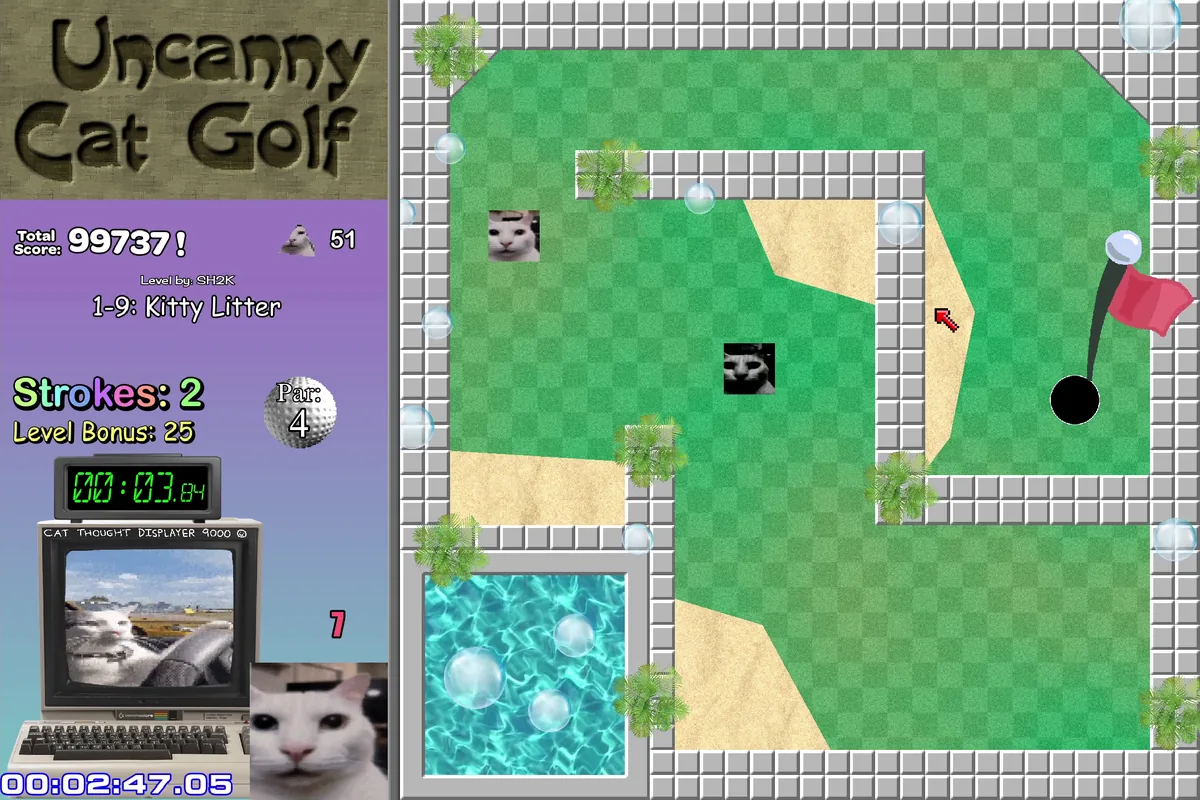
Instead of asking how to reach the hole immediately, ask where you would like to stand for the final putt. A broad, open approach can be worth an extra setup shot if the direct route passes close to trouble. Work backwards from that approach to your current position. The resulting plan may look less impressive than a long bank shot, but it is easier to judge and easier to repeat. A useful intermediate position is progress even when the hole is still some distance away.
Make that plan flexible. The cat may stop slightly short or rebound into an unexpected area. Reassess the new position rather than insisting on the exact route you imagined before the first stroke. Look for the widest safe corridor now available. Golf rewards the shot you can make from the actual lie, not the shot you wished you had prepared. On an unfamiliar course, collecting a few reliable landing positions is a stronger foundation than memorising one ambitious opening move.
Bank shots need somewhere to finish
A wall can create an indirect route when the straightforward line is blocked. Picture the incoming direction, the contact point, and the outgoing space before using it. Do not focus only on hitting the wall. A successful rebound still needs enough room to settle afterwards. If a tiny error at the contact point would send the cat toward a hazard, consider whether a shorter repositioning shot gives you a less sensitive angle on the following turn.
Avoid treating a drawn angle as a guarantee of perfect real-world reflection. This is a game with its own collision behaviour, not a geometry exam. Your first rebound is a test of the build you are playing. Observe whether the piece loses substantial speed, catches a corner, or continues farther than expected. Use that observation for your next decision. A slower, clearer bank shot often teaches more than a powerful ricochet that crosses several obstacles before you can identify the important contact.
Give water, sand, and narrow edges extra space
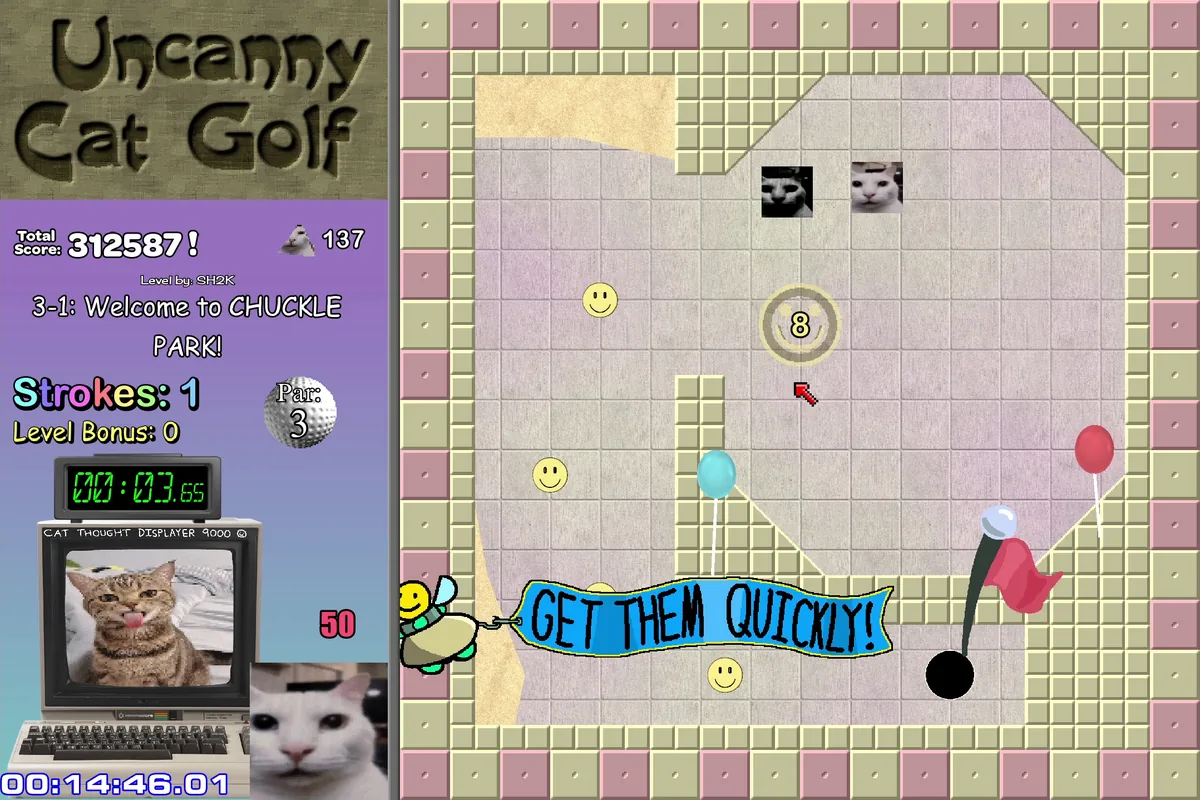
When the course presents water, sand, or a tight boundary, identify it before adjusting the aiming line. These areas change the value of a shot even when the hole appears close. A route that only works with a perfect release is not automatically the best route. Allow a margin on both sides of your intended landing point, especially while you are still learning how far the cat travels at different strengths. The safe area should be larger than your uncertainty.
Judge each surface by what the current game actually shows. Do not assume a particular penalty count or resistance value without seeing it. If an attempt goes wrong, use the result as a map update: which section was dangerous, where did control disappear, and what safer approach remains? This keeps a mistake from becoming a chain of rushed recovery shots. A little patience before the next release is usually cheaper than repeating a risky line simply because it nearly worked once.
Use par as a reference, not a reason to rush
Where the game displays par or a stroke count, use it to compare attempts on the same layout. Your first visit is a scouting round. Find the hole, learn the space, and finish if you can. On a later attempt, ask which stroke served no useful purpose. Perhaps an opening shot left a difficult angle, or a recovery used too much power. Removing one avoidable correction is a more concrete goal than demanding an immediate perfect score.
Keep your notes simple enough to remember without pausing after every action. Something like 'short opening, approach from the open side, gentle finish' is more useful than an elaborate sequence of untested instructions. We do not claim a fixed score is optimal for every course or version. The practical win is a plan that survives small variations. If your next round uses fewer emergency corrections, your control is improving even before the displayed total becomes especially impressive.
Build an Uncanny Cat Golf practice routine
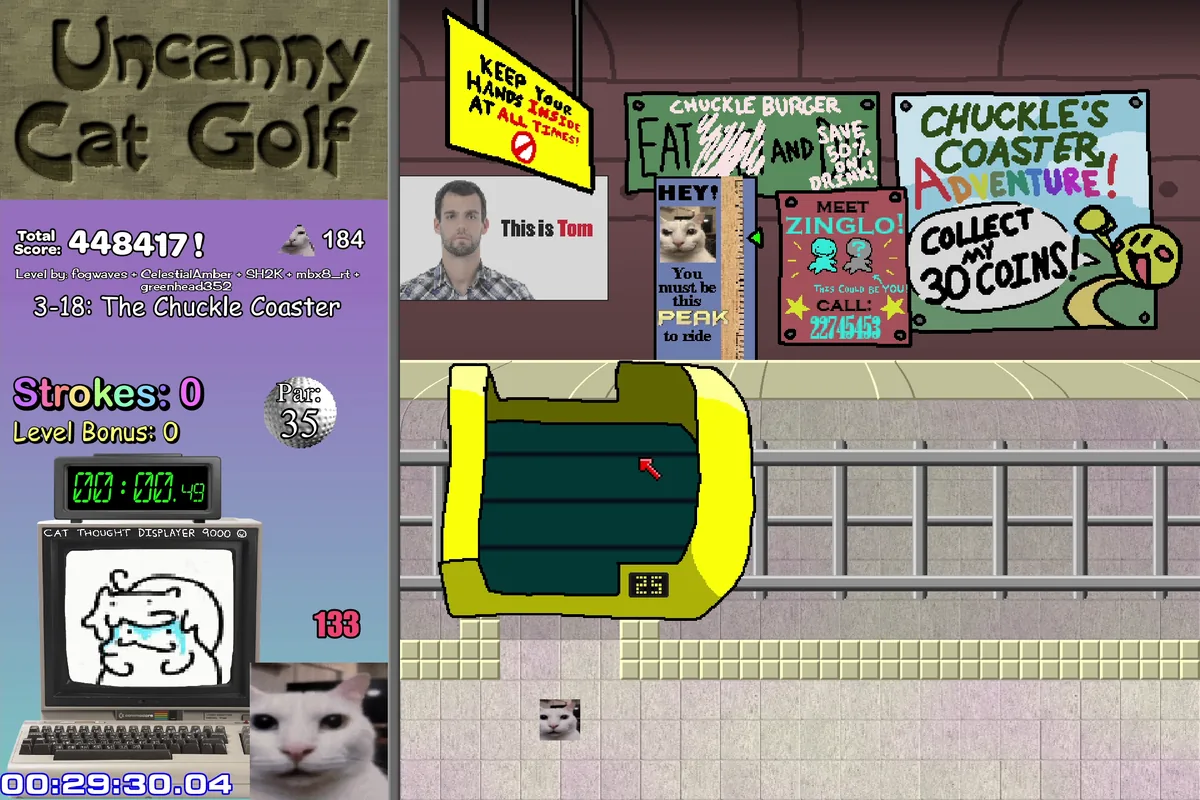
Give the next three attempts different jobs. On the first, explore: find a safe route and observe how much room a normal shot needs. On the second, repeat the opening as closely as possible so you can see whether the result is consistent. On the third, change only the most obvious weakness. This small routine stops a session from becoming a string of unrelated guesses. You do not need a notebook full of measurements, but a clear question before each release helps you recognise an answer afterwards.
For example, suppose your first shot reaches the correct side of an obstacle but leaves a narrow angle toward the hole. The useful experiment is not necessarily more power. A shorter shot might stop before that awkward angle develops, while a slightly wider line might create a more forgiving approach. Choose one possibility and test it. If the result is worse, you still learned something about the layout. Good practice is a sequence of understandable decisions, including the decisions that fail.
Review the final shot separately from the opening. Players often remember a dramatic long rebound and overlook the small overhit that added two extra strokes at the end. A gentle finish deserves its own practice because it uses a different power range. When you can reliably leave the cat close to a target without racing past it, that control also improves your recovery shots elsewhere on the course. The aim is not to make every action cautious; it is to know when a small action is enough.
Keep the weirdness fun, and know when to stop
Uncanny Cat Golf mixes its putting challenge with deliberately odd and sometimes unsettling imagery. That is part of its identity, not evidence that your browser has broken. Nevertheless, visual surprises and flashing imagery will not suit everyone. If you are sensitive to flashing effects, choose a different game rather than assuming this page can disable effects inside the external frame. Lowering sound can make a session more comfortable, but it does not remove visual triggers.
For a short desk break, set a small goal: finish a layout, practise one rebound, or improve a single approach. Stop when you achieve it instead of turning every miss into a demand for another attempt. Pen Fight remains available in the cards above when you want direct opponent contact again, while Cluck Battle offers a very different microphone-driven challenge. These are separate games, so this website does not transfer progress, scores, or unlocks between them.